HEPO — Software for People, Culture and Processes
Understand and develop organizational culture, coordinate business processes, and explore work through simulation and games on one software platform.

Evaluate scoped operational evidence against your trait definitions and inspect the observations, confidence, and source context that feed culture readings.
The Evaluation Engine is the HEPO component that reads operational evidence against the organization's trait definitions and produces structured observations. People & Culture operators and implementers configure its observation scope, inspect the evidence, and monitor the evaluation process.
The engine connects the Trait Catalogue to the Culture Index. Definitions establish what to examine; observations provide the material from which the index builds readings.
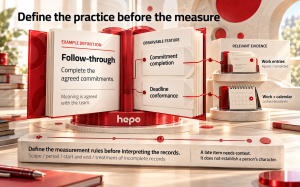
A team has defined reliable follow-through in terms of agreed commitments and deadlines. Relevant work records show what was committed and completed; linked calendar information provides the expected timing. The agreed observation scope establishes which team and period the evaluation concerns.
The engine evaluates the supplied evidence against that definition. Its output identifies the trait, the evidence that informed the observation, and the associated confidence. An operator can examine the source context before interpreting the result.
This is a different question from whether a colleague was prominent in a meeting or quick to reply. Those impressions may attract attention, but a claim about follow-through needs evidence relevant to the commitment. Even then, the records may require explanation: a changed deadline or dependency can alter what a delay means.
Evidence can come from HEPO's operational modules and scoped integrations with existing systems. Work, communication, calendar events, and presence provide different kinds of context. Integration transforms the selected business signals into the structured evidence the engine consumes.
An evidence record carries the characteristic it relates to, a value, a timestamp, a subject, confidence information, and a provenance trace. These fields let the evaluation work with more than an isolated count and let a reviewer investigate where the input came from.
The presence of a record in a system does not, by itself, make every use of it appropriate. The organization establishes which sources and populations belong in the intended reading. Visibility Without Surveillance explains that boundary.
Observation scopes identify the subject of the reading: a department, team, role group, or organization, with selected traits and thresholds. Sensitivity, temporal resolution, and confidence thresholds shape how the evidence is evaluated.
The engine's control room provides an operational view of the pipeline, including throughput, evidence queues, and assessment activity. This helps the responsible team distinguish a cultural reading from a problem in the flow of evidence. A stalled input or an unsuitable threshold calls for investigation of the configuration, not an immediate conclusion about the people doing the work.
Implementers establish adapters and running parameters with the organization. People & Culture owners bring the definition and the question; the technical team makes the agreed evidence usable and the pipeline inspectable.
| Part of the output | Why it matters |
|---|---|
| The trait being observed | Identifies the definition to which the observation belongs |
| Supporting evidence and source context | Gives the reviewer a route back to the material used |
| Timing | Places the observation in a period and sequence |
| Confidence | Helps distinguish a more supported reading from one needing caution or further evidence |
The observation is an input to interpretation, not a verdict on an individual. The Culture Index combines observations into readings that can be examined across time. Recommendations come later in the sequence, and a responsible person decides how to respond.
The same evaluation architecture accommodates cultural, business, and process evidence. For a business reader, the practical distinction remains between People & Culture Orchestration and Process Orchestration. The engine supplies evaluation within that wider platform; it is not a separate offering or the component that independently authorizes people decisions.
AI-assisted evidence extraction follows HEPO's local deployment approach. Integration scope, field mappings, synchronization, and access are established for the customer's environment. Data Integration and the System Layer explain those supporting responsibilities.
After people review a recommendation and undertake development, the resulting activity and impact records can inform subsequent evaluation. This connects the later modules back to the evidence base.
Feedback gives the organization something to review when tuning definitions and rules. It does not mean the system autonomously changes the organization's values or proves a decision correct because a later score improved.
Your delivery partner supports the configuration and review cycle with the operation. Begin with a defined question, identify its evidence path, and inspect the resulting observations before extending the scope.
Next: the Culture Index → · Return to the Trait Catalogue →
Walk us through the evidence behind one development question.
Understand and develop organizational culture, coordinate business processes, and explore work through simulation and games on one software platform.

Six connected software modules help you define cultural traits, examine evidence, interpret patterns, organize development, and review outcomes.
Adapt and author the traits, observable features, and evidence definitions that HEPO uses to examine your organization's working culture.
Manage the people, work, events, communication, knowledge, and relationships that support HEPO's three offerings alongside existing business systems.
Understand the boundaries between cultural readings, personal participation records, evidence access, and the human decisions that follow.
The management method behind HEPO's six P&C modules: define meaningful practices, examine evidence, retain human judgment, and review development outcomes.
Design development campaigns, organize employees' programmes, and connect milestones, work, learning materials, feedback, and approved recognition.

Bring evaluated observations into composite cultural readings, examine trends and confidence, and identify patterns for a responsible person to investigate.
Connect voluntary check-ins, assessments, wellbeing indicators, recurring practices, and impact review to the next people-development decision.
Generate traceable proposals from configured signals and rules, review their basis, manage the response, and examine the resulting impact.