HEPO — Software for People, Culture and Processes
Understand and develop organizational culture, coordinate business processes, and explore work through simulation and games on one software platform.

Bring evaluated observations into composite cultural readings, examine trends and confidence, and identify patterns for a responsible person to investigate.
The Culture Index is HEPO's module for bringing evaluated observations together into cultural readings. A People & Culture leader can examine a defined measure, its direction and speed of change, its supporting context, and the thresholds the organization has chosen to monitor.
Its output gives the next conversation a specific subject: what changed, how well the evidence supports the reading, and whether it warrants investigation or a response. It receives observations from the Evaluation Engine and supplies signals to the Recommendation Framework.
A quarterly review presents “engagement: 7.2.” Before using that number, the room needs to know what it measures, what contributed to it, and whether this quarter is comparable with the last.
A culture index applies that discipline to the organization's defined practices. It combines observations into a measure positioned on a defined scale. Its usefulness depends on being able to examine the definition and supporting evidence, rather than treating the number as self-explanatory.
For the team examining reliable handoffs, the question might be whether its follow-through reading is improving, stable, or declining. A change should be considered alongside the period, evidence coverage, and any changes in the work or definition. The reading helps locate a question; the team supplies context for answering it.
The starting index configuration includes four kinds of reading:
| Index | The question it helps examine |
|---|---|
| Culture Coherence | How consistently do the cultural components fit together? |
| Culture Volatility | How much are the readings fluctuating over time? |
| Culture Friction | Where do components appear to conflict or compete? |
| Alignment Gap | How far does the measured pattern differ from the culture the organization configured? |
These measures help people discuss different aspects of the same situation. Determination rising while steadiness falls raises a different question from both falling together. Volatility describes fluctuation; it does not, by itself, tell you whether the cause is changing practice, changing evidence, or measurement noise.
| Part | What to examine |
|---|---|
| Composite value | The combined measure for the relevant definition |
| Normalized position | Its position on a common scale |
| Trend direction | Whether the reading is rising, stable, or falling |
| Trend velocity | How quickly it is moving |
| Confidence information | The support and uncertainty associated with the reading |
| Provenance | The observations and evidence behind the result |
The platform's seeded example includes Dignity at 0.78, rising, with accompanying confidence bounds of 0.72–0.84. This is demonstration data for understanding the record, not a customer result or a benchmark every organization should aim for. A populated confidence field is not, on its own, proof of measurement accuracy; interpretation depends on how the reading and its uncertainty were produced.
Historical snapshots provide the sequence needed to examine movement. The starting configuration includes daily snapshots; the useful cadence and comparison window should fit the organization's review rhythm. A change in definition or calibration also needs context when comparing periods.
The organization configures observation scopes, monitored traits, and thresholds. Severity levels can distinguish an informational reading from one that needs attention, with notification roles identifying who should receive it.
The monitoring view makes that configuration visible. People need to understand which group and subject a reading concerns before acting on it. Tenant-specific overlays support local calibration; their use should remain clear when explaining how a reading was produced.
P&C cultural readings concern team and organizational patterns. They are not an employee league table. Personal programme progress and voluntary participation records have separate purposes and should not be relabeled as an individual's cultural worth. Read the trust explanation →
The People & Culture owner identifies the question and reviews the evidence. Consultants help leaders learn the vocabulary of coherence, fluctuation, friction, and alignment, including when a change needs investigation rather than immediate intervention. Implementers configure scopes, windows, thresholds, and history. The delivery partner supports the continuing review with the organization.
This is a practical complement to other reports and conversations. Different instruments answer different questions; the useful comparison is whether each measure has a clear definition and evidence appropriate to the decision.
When a configured condition is met, the Recommendation Framework can create a proposal for a responsible person to consider. The reading supplies a signal, not the authority to act.
Next: the Recommendation Framework → · Return to the Evaluation Engine → · People & Culture overview →
Bring us a cultural reading your team needs to understand more clearly.
Understand and develop organizational culture, coordinate business processes, and explore work through simulation and games on one software platform.
Six connected software modules help you define cultural traits, examine evidence, interpret patterns, organize development, and review outcomes.
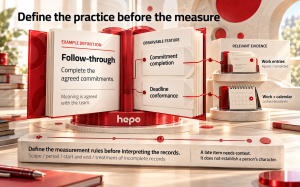
Adapt and author the traits, observable features, and evidence definitions that HEPO uses to examine your organization's working culture.
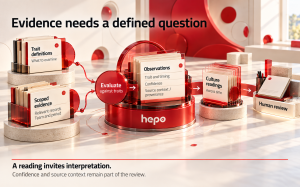
Evaluate scoped operational evidence against your trait definitions and inspect the observations, confidence, and source context that feed culture readings.
Manage the people, work, events, communication, knowledge, and relationships that support HEPO's three offerings alongside existing business systems.
Understand the boundaries between cultural readings, personal participation records, evidence access, and the human decisions that follow.
The management method behind HEPO's six P&C modules: define meaningful practices, examine evidence, retain human judgment, and review development outcomes.
Design development campaigns, organize employees' programmes, and connect milestones, work, learning materials, feedback, and approved recognition.
Connect voluntary check-ins, assessments, wellbeing indicators, recurring practices, and impact review to the next people-development decision.
Generate traceable proposals from configured signals and rules, review their basis, manage the response, and examine the resulting impact.