HEPO — Software for People, Culture and Processes
Understand and develop organizational culture, coordinate business processes, and explore work through simulation and games on one software platform.

The management method behind HEPO's six P&C modules: define meaningful practices, examine evidence, retain human judgment, and review development outcomes.
HEPO's People & Culture method connects an organization's understanding of good work to evidence, interpretation, development, and outcome review. The software implements that method through six connected modules. This page explains why those parts belong together and how an organization makes the approach its own.
For the direct software introduction, begin with the People & Culture overview. The method adds depth to that explanation; it is not a prerequisite for understanding what the modules do.
People & Culture work extends beyond maintaining employee records. It includes understanding how colleagues work together, how responsibilities are carried, and how people develop. Those questions concern practices and relationships that a record of employment or an isolated transaction does not fully describe.
HEPO begins by connecting the question to the operation. If a team wants more reliable handoffs, what would reliable mean? Which commitments and practices would demonstrate it? What evidence is relevant, and who has enough context to interpret it?
The software follows that question through development and review, so a reading has somewhere useful to lead.
A trait is a defined characteristic of how work happens. Feature units identify observable aspects of that characteristic. For follow-through, those might include commitment completion and deadline conformance, connected to relevant work and calendar records.
An anti-trait describes a counter-pattern: what undermines the intended practice, imitates it without substance, or is sustained by the surrounding system. Considering both directions helps people examine a definition more honestly than looking only for confirming examples.
Human-assigned people attributes remain a separate form of context. A preference, an assessment of potential, and an observed pattern are different claims. Keeping them distinguishable matters when someone interprets a reading or makes a decision about development.
The Trait Catalogue supplies a starting vocabulary and a place to adapt it. The organization owns the definitions and their use; supplied content does not remove the need to establish local meaning.
The method draws on psychology for patterns and biases; behavioral economics for incentives and defaults; business administration for organizational purpose; industrial engineering for how work flows; labor studies for how work is experienced; and software engineering for the connection between a definition and usable evidence.
These disciplines contribute questions and constraints. Together, they help a team ask whether the proposed reading concerns something meaningful, whether its evidence is appropriate, and whether the result can inform a responsible action.
The authored books behind HEPO develop this reasoning at greater depth, across People & Culture and Ethical Management. The Resources collection provides access to the supporting material; the About section explains the relationship between the intellectual work and the software.
Work records can reveal patterns that are hard to reconstruct from memory. Participant accounts can reveal experiences and context that those records do not contain. The method needs an explicit distinction between them, rather than treating one as a complete replacement for the other.
McKinsey's Organizational Health Index research examines management practices and organizational performance, using survey-based assessment. That supports the relevance of examining working practices; it does not establish that HEPO's measurements are equivalent to OHI or that surveys have no value. Read McKinsey's account of the updated research.
HEPO's own sequence combines defined operational evidence with a later review of development and wellbeing, including voluntary pulses and assessments. A finding about another instrument is context for the method, not validation of a HEPO outcome.
| Module | The handoff question, carried forward |
|---|---|
| Trait Catalogue | Agree what reliable follow-through means and what can evidence it |
| Evaluation Engine | Read the selected records within the agreed scope and produce observations |
| Culture Index | Examine the resulting pattern and its movement over time |
| Recommendation Framework | Consider a proposal generated by a configured condition and inspect its basis |
| Achievement Campaigns & Programmes | Organize the development work a responsible person chooses |
| Flourish & Wellbeing | Review subsequent evidence and experience, then decide what to continue or change |
The sequence is a working cycle, not an automatic claim that each stage makes the organization better. Its value lies in connecting the definition, evidence, decision, work, and review so people can examine what they are doing.
The person responsible for a decision needs to inspect the evidence and bring context to it. A recommendation is a proposal; a cultural pattern is not a verdict on an individual. The organization governs observation scopes, access, recipients, and responses.
The fact that records already exist does not settle whether a particular analysis is appropriate. The trust explanation sets out the practical distinctions that must remain visible during implementation and use.
Process Orchestration coordinates the work and decision paths in which people participate. Simulation & Gamification gives teams ways to explore information, rehearse a declared scenario, or learn through an activity. These are complementary offerings on the same platform, with different kinds of output.
Ethical Management is a worked application within Solutions. It offers a framework to examine and adapt; using P&C software does not require accepting that framework as the organization's ethical standard.
Your people define the question and its meaning. Consultants help develop definitions and interpretation skills. Implementers establish the evidence and configuration. The delivery partner connects these contributions through the first use and subsequent cycles.
Start with a question the organization can evaluate in its own work. Keep the decision owner involved as the definition becomes a reading and the reading becomes a possible response.
Understand and develop organizational culture, coordinate business processes, and explore work through simulation and games on one software platform.

Six connected software modules help you define cultural traits, examine evidence, interpret patterns, organize development, and review outcomes.
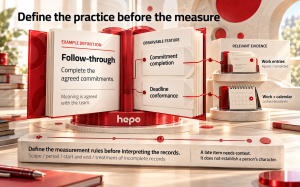
Adapt and author the traits, observable features, and evidence definitions that HEPO uses to examine your organization's working culture.
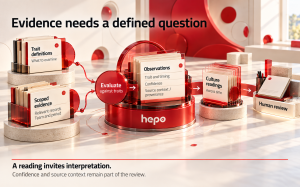
Evaluate scoped operational evidence against your trait definitions and inspect the observations, confidence, and source context that feed culture readings.
Manage the people, work, events, communication, knowledge, and relationships that support HEPO's three offerings alongside existing business systems.
Understand the boundaries between cultural readings, personal participation records, evidence access, and the human decisions that follow.
Design development campaigns, organize employees' programmes, and connect milestones, work, learning materials, feedback, and approved recognition.
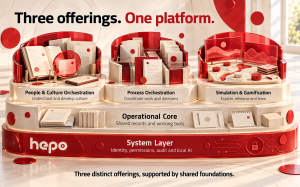
Bring evaluated observations into composite cultural readings, examine trends and confidence, and identify patterns for a responsible person to investigate.
Connect voluntary check-ins, assessments, wellbeing indicators, recurring practices, and impact review to the next people-development decision.
Generate traceable proposals from configured signals and rules, review their basis, manage the response, and examine the resulting impact.