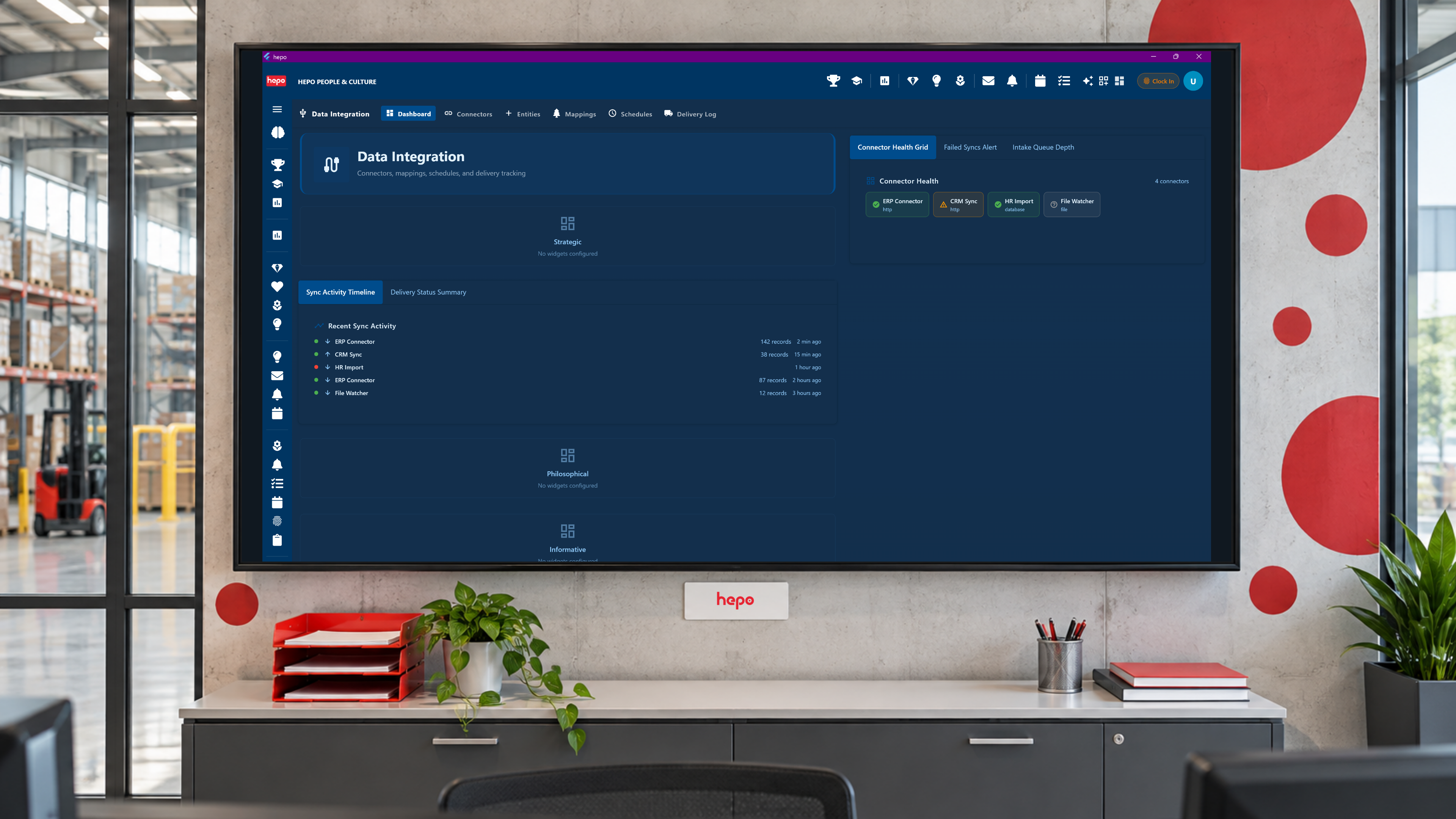
Process Orchestration
Define and run business decision paths: gather evidence, route work, execute authorized steps, keep human approval gates, and review performance.

Configure sources, field mappings, synchronization, and delivery logs; distinguish incoming evidence from explicitly authorized writeback.
Data Integration is HEPO's software for connecting agreed external systems to the platform's records and processes. Implementers configure connectors, map fields, establish synchronization, and inspect delivery results. Process owners use the resulting information in work and evaluation.
An ERP can remain the authority for its transactions while HEPO coordinates the decisions around them. The integration defines precisely which information crosses that boundary and, where supported and authorized, which results are sent back.
A quotation approval may need a customer record, credit information, and transaction history from existing systems. The connector reads the agreed source, maps the relevant fields, and supplies usable records. Those records join HEPO's work and communication context.
A reviewer needs to know which customer the information concerns, when it was obtained, and whether the latest synchronization succeeded. A missing or stale import is an integration issue to investigate before drawing a business conclusion.
If the approved process includes returning a decision to the external system, that is an outbound operation with its own permission, adapter support, payload, and delivery result. Reading a record does not imply permission to update it.
| Part | What the implementer establishes |
|---|---|
| Connector | The system, endpoint, authentication, connection parameters, pagination, and rate limits |
| Connector entities | Which external entities are represented and how they relate to HEPO records |
| Field mappings | How source fields become the expected fields and values in the receiving schema |
| Schedules and triggers | When synchronization runs and which supported events can initiate it |
| Delivery logs | The attempt, source or destination, timing, result, and information needed to investigate failure |
| Health view | Connector status, synchronization activity, and errors needing attention |
The framework and a working connection to a particular system are separate deliverables. Implementation establishes the available adapter, permitted operations, source schema, authentication, and expected volume. An external product name alone does not establish a ready-to-use integration.
Field mapping deserves the same attention as the connection. A customer's external identifier, a timestamp, and a status value need agreed meanings. A successful transfer is only useful if the resulting record can be related to the right case and interpreted correctly.
Incoming synchronization supplies context from transactions, master data, and organizational structure. It supports the evidence pipeline and the process steps configured to use those records.
Outbound delivery uses a connector that supports writing and a separately permitted writeback process. Delivery reporting distinguishes sent, confirmed, failed, and retrying records. An approval recorded in HEPO and confirmation from the destination are different events; the operator should be able to establish which has occurred.
For the quotation, the owner may choose to keep the decision in HEPO, deliver it through a supported connector, or use another agreed handoff. The scope is established during implementation. HEPO's role here does not replace general-ledger accounting, inventory valuation, payroll processing, tax calculation, or financial consolidation.
Schedules define a cadence suited to the source and the decision. Event-triggered intake is useful where the source and connector support it. The owner must understand what the selected arrangement means for freshness; a frequent schedule is not proof that every record is current.
Delivery records give an administrator a starting point for tracing what crossed the connection and what needs another attempt or correction. Health indicators help separate a process problem from missing evidence. Follow the record back through the mapping and delivery context when its value or identity looks wrong.
Integration credentials also belong in the access design. A business approver's HEPO authority does not automatically grant a connector permission in the external system. The organization and implementer establish both sides of the operation and the responsibility for their use.
For the shared connector, mapping, schedule, and delivery responsibilities, see System Layer: Data Integration. This Process page follows their use in a business decision.
Imported records can supply a process step and contribute to the evidence used in evaluation. The Orchestrator coordinates permitted execution; Process Analytics helps review the resulting work. Keeping these jobs distinct makes it easier to explain whether a displayed result came from an external transaction, a calculation, or a later interpretation.
The connection runs within the agreed deployment. Local AI inference is a separate processing choice from communicating with an authorized external business system. The integration specification records those boundaries rather than implying that no network exchange occurs.
Your process owner identifies the business purpose and source authority. Implementers configure and verify the connection, including failure handling; the delivery partner coordinates it with the people responsible for the existing system.
Bring us the source systems and information one process needs.