HEPO — Software for People, Culture and Processes
Understand and develop organizational culture, coordinate business processes, and explore work through simulation and games on one software platform.

Adapt and author the traits, observable features, and evidence definitions that HEPO uses to examine your organization's working culture.
The Trait Catalogue is HEPO's software for defining the characteristics of work your organization wants to understand and develop. People & Culture teams use it with colleagues and implementation partners to name traits, describe observable practices, and connect those definitions to relevant evidence.
Its output is a versioned vocabulary that the Evaluation Engine can use. Supplied definitions give you a starting point; your organization reviews, adapts, and extends them.
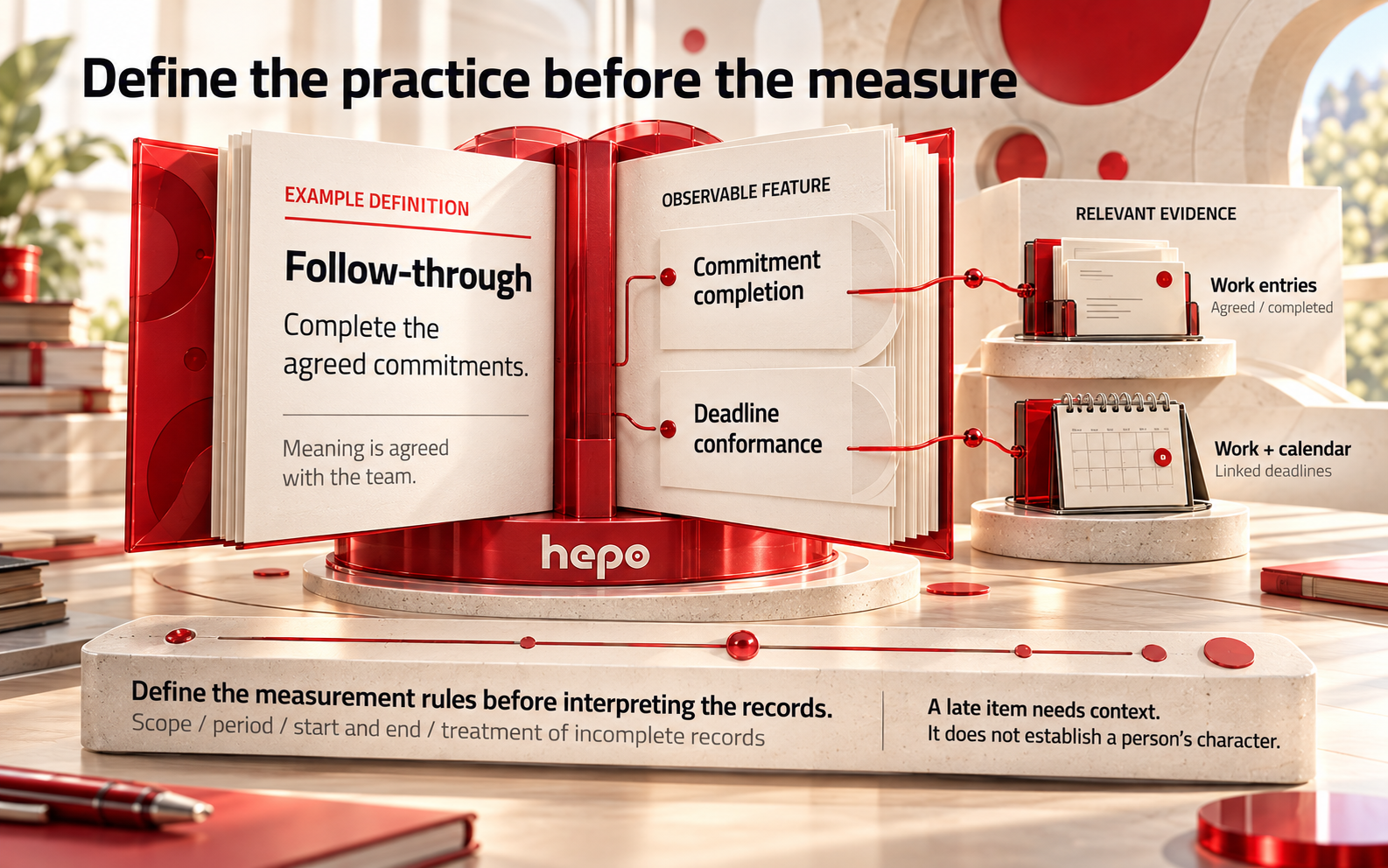
Suppose a team wants more reliable handoffs. “Improve collaboration” expresses an intention, but it leaves several questions open. Does the team mean completing the agreed work, communicating a delay early, or giving the next colleague enough context to continue?
The catalogue helps make that meaning explicit. For a follow-through definition, the team can identify commitment completion and deadline conformance as observable features, with work entries and deadline-linked calendar events as relevant sources. The people doing the work help establish what those records can reasonably show.
The result gives evaluation a defined subject. An overdue item can contribute evidence about a handoff; it does not explain the cause of the delay or establish a person's character by itself.
| Part | What you establish |
|---|---|
| Name and description | The characteristic and its meaning in your operation |
| Systemic role | Whether the trait provides a foundation, helps other practices develop, or sustains them under pressure |
| Polarity spectrum | Described lower, middle, and upper positions that give a reading meaning |
| Semantic anchors | Relevant words and contexts, including patterns that count against the trait |
| Data affinity | The evidence channels that can inform the reading and their configured reliability |
| Feature units | Observable aspects that connect the definition to activity |
For example, the supplied Dignity definition includes clarity, reliability, composure, respect, and self-containment as feature units. These connect the larger idea to questions about communication, commitments, escalation, professional regard, and scope discipline. Their interpretation still needs the context of your work.
Version history records changes to definitions. Keeping that history matters when reviewing an earlier reading: people need to understand the definition and evidence context used at the time, rather than silently applying today's meaning to yesterday's record.
The starting culture catalogue contains ten core traits. Their roles and motifs come from HEPO's methodological work:
| Trait | Role | Motif in the method |
|---|---|---|
| Dignity | Foundational | The Anchor |
| Integrity | Foundational | The Compass |
| Honor | Catalytic | The Shield |
| Gravitas | Stabilizing | The Pillar |
| Generosity | Catalytic | The Spring |
| Bravery | Catalytic | The Flame |
| Sacrifice | Stabilizing | The Bridge |
| Determination | Foundational | The Current |
| Steadfastness | Stabilizing | The Root |
| Fortitude | Stabilizing | The Bedrock |
The motifs help explain the method; the descriptions, features, and evidence connections make the definitions usable in software. The vocabulary is a starting framework, not a requirement that every organization assign identical meaning or priority to each trait.
The shared definition system also accommodates business and process measures, such as work cycle time, rework, blocked duration, event attendance, and meeting cost. Those are evidence subjects within the platform, not additional commercial offerings.
An anti-trait describes a pattern that erodes the practice a trait represents. The supplied catalogue includes thirty anti-traits, organized in three forms for each core trait:
These definitions make it possible to examine both the desired practice and its erosion along a polarity. Configured descriptors address matters such as persistence, spread, detectability, and escalation. They provide a framework for interpretation; they are not measured universal constants about human behavior.
People attributes provide a separate kind of context. The starting set includes fifteen attributes across agency orientation, handling uncertainty, effort and reward, social orientation, and time orientation. Examples include initiative locus, ambiguity tolerance, recognition sensitivity, collaboration preference, and planning horizon.
These are human-assigned descriptions, distinct from evidence-based trait evaluation. Neither end of an orientation is inherently better. A colleague's preference for independent work, for example, should not silently become a negative collaboration score.
Your people supply the meaning and working context. Consultants help translate that meaning into observable definitions, including counter-patterns and useful limits. Implementers connect the agreed features to available evidence. The delivery partner coordinates this work and later revisions with the organization.
Start with a characteristic relevant to a real decision, and establish what would count as evidence for and against it. That gives the next module something specific to evaluate.
Next: the Evaluation Engine → · The method behind the definitions → · People & Culture overview →
Bring us one working practice you want to define more clearly.
Understand and develop organizational culture, coordinate business processes, and explore work through simulation and games on one software platform.

Six connected software modules help you define cultural traits, examine evidence, interpret patterns, organize development, and review outcomes.

Evaluate scoped operational evidence against your trait definitions and inspect the observations, confidence, and source context that feed culture readings.
Manage the people, work, events, communication, knowledge, and relationships that support HEPO's three offerings alongside existing business systems.
Understand the boundaries between cultural readings, personal participation records, evidence access, and the human decisions that follow.
The management method behind HEPO's six P&C modules: define meaningful practices, examine evidence, retain human judgment, and review development outcomes.
Design development campaigns, organize employees' programmes, and connect milestones, work, learning materials, feedback, and approved recognition.

Bring evaluated observations into composite cultural readings, examine trends and confidence, and identify patterns for a responsible person to investigate.
Connect voluntary check-ins, assessments, wellbeing indicators, recurring practices, and impact review to the next people-development decision.
Generate traceable proposals from configured signals and rules, review their basis, manage the response, and examine the resulting impact.