Operational Core — The Records Behind the Work
Manage the people, work, events, communication, knowledge, and relationships that support HEPO's three offerings alongside existing business systems.

Connect report definitions, measures, source records, and execution context so reviewers can understand what a result represents.
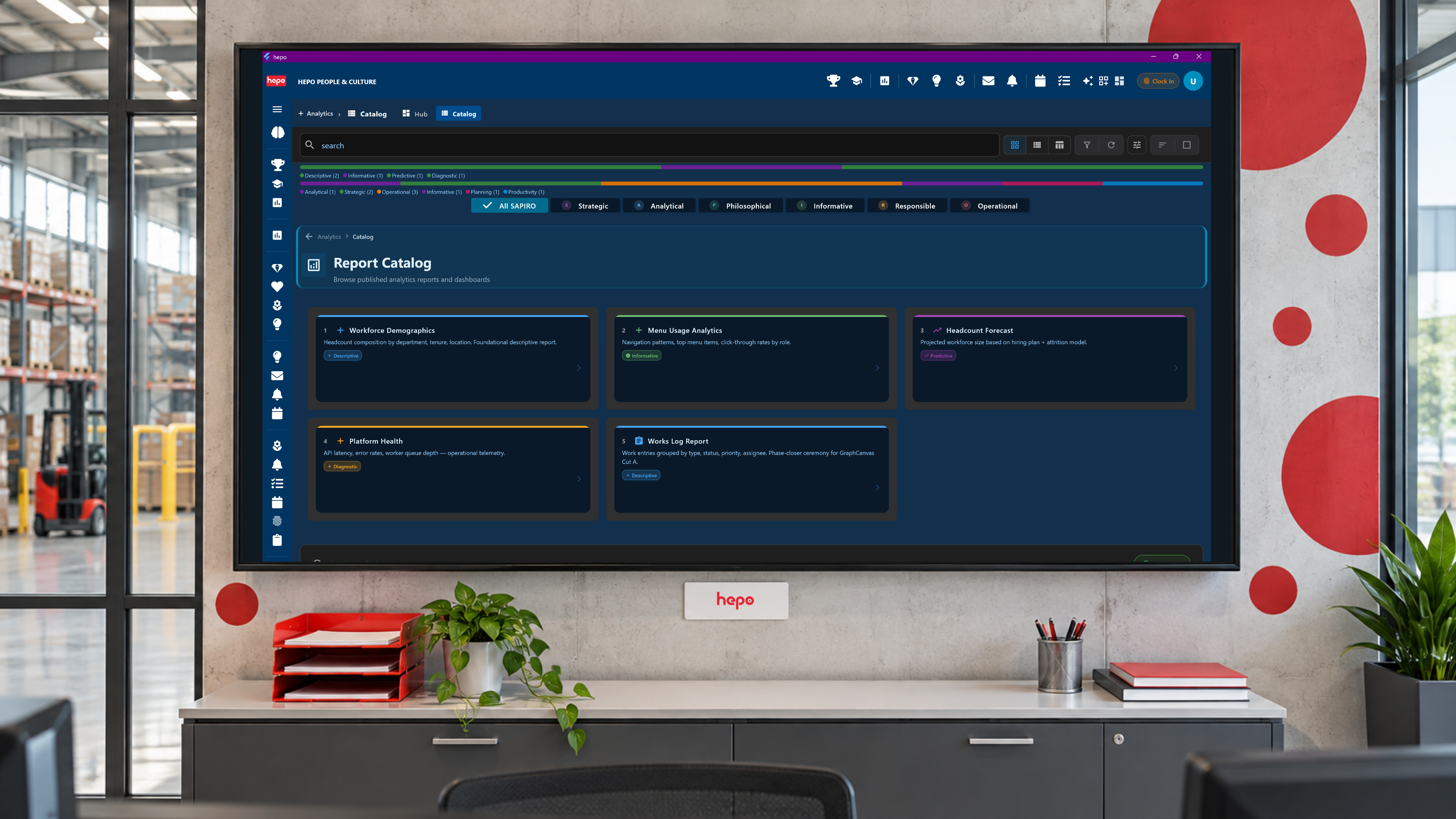
Reports & Analytics provides HEPO's reporting foundation: the definition of a report, its data and measure bindings, and the process used to produce a result. Report owners and implementers establish what the report asks and how it should run; readers examine the output with the context needed to interpret it.
HEPO treats a report as a process. Its preparation, execution, review, and later rerun can therefore be designed as work with explicit responsibilities.
An operations review asks how much work was completed during a period and how much returned for rework. The report needs a definition of completion, a date range, relevant work types, and a rule for counting returns. It also needs to make clear which records were available when it ran.
The resulting figure is useful when a reviewer can understand those choices. A later run may differ because records, filters, or definitions changed. Rerunning a report is not necessarily reproducing the same historical result.
| Concern | What the report owner establishes |
|---|---|
| Measures | What is counted or calculated, with meaningful units |
| Dimensions | How the result is grouped, such as period, unit, or site |
| Sources and bindings | Which supported records or data services supply the information |
| Process binding | How the report is invoked and any preparation or review steps |
| Run context | The relevant parameters, time, outcome, and available execution record |
| Access | Who may request, inspect, or receive the result |
HEPO's reporting architecture includes report metadata and binding surfaces, alongside analytical definitions and monitoring. The available configuration and execution path should be demonstrated for the intended report. A reporting design is not evidence that every measure or authoring surface is ready in every deployment.
Shared records can support reporting across work, presence, projects, or other modules. The required query and data preparation still need definition. A common operating model does not eliminate transformations, aggregation, or the need to inspect the source coverage.
The semantic layer gives measures and dimensions an explicit meaning. Changes should be governed with attention to dependent reports and historical comparisons. Exports can be useful delivery artifacts, but the exported file alone may not retain all the context of the run.
Process Analytics develops the interpretation of process performance and possible responses. Culture Indices concerns readings derived from trait evaluation. Reports & Analytics supplies the shared reporting foundation: definitions, bindings, execution, and presentation.
Consultants help clarify what a useful measure means. Implementers build and verify the required report path. The owner reviews representative source records, a normal run, a failed run, and a rerun before using the output for decisions.