Operational Core — The Records Behind the Work
Manage the people, work, events, communication, knowledge, and relationships that support HEPO's three offerings alongside existing business systems.

Bring typed messages, feedback, recognition, approvals, and meeting exchanges into a shared inbox with their working context.
Communication Hub is HEPO's module for holding exchanges as typed records connected to the people and work they concern. Its unified inbox brings the supported communication types into one stream, while filtering and classification help a participant distinguish a message, an announcement, feedback, recognition, or another kind of exchange.
The hub supplies the conversation record. People & Culture and Process Orchestration give relevant communication their defined analytical or operational use; access and purpose govern that use.
A team discusses a delayed shipment, records the agreed response, and follows up on the associated work. Relating the exchange to the work item and project lets a later reviewer find that context from the subject itself.
A discussion and an authorised decision are different things. The appropriate communication type, decision record, and process step need to make that distinction visible. Merely labelling a message does not execute an approval.
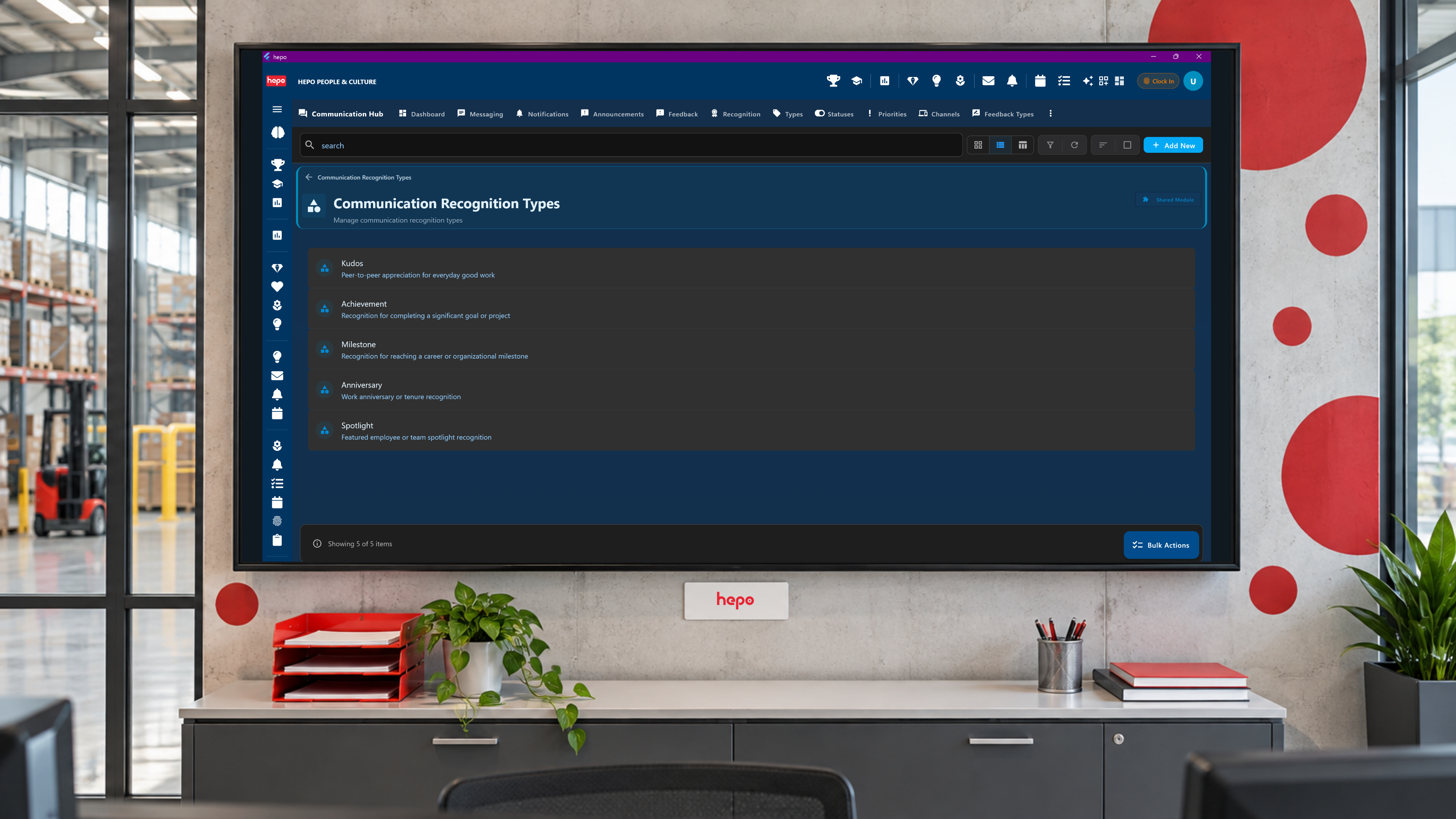
The described hub covers fifteen communication types: messaging, announcements, automation events, approvals, direct communication, email events, feedback, meeting notes, notifications, phone calls, platform messages, publishing, recognition, scheduling, and AI conversations. The enabled surfaces and connections determine what enters the deployment's inbox.
Classification can include channel, medium, priority, status, lifecycle, sentiment, and intent. These dimensions support retrieval and interpretation. Where sentiment or intent is assigned or inferred, it remains an interpretation to examine in context rather than proof of what someone felt or meant.
An exchange can be related to its sender and recipients, the work it discusses, the event it follows, or the project it serves. Interaction views can bring relevant exchanges into other modules, while the inbox offers a broader permitted view.
Recognition can therefore remain connected to the contribution it acknowledges. Meeting notes can remain connected to the review they describe. The configured relationships give a practitioner a better starting point than the message text alone.
The organisation chooses types, channels, participants, and retention responsibilities. Implementers connect the supported sources and views. Start with one sequence: a message about a work item, a recorded follow-up, and recognition of a contribution. Check how each is found from the inbox and from its subject.
Cultural use follows the visibility boundary. The existence of a communication record does not permit unrestricted analysis of it. Local AI explains the inference boundary where interpretation is used.
Works and Calendar provide the activity context around the exchange.