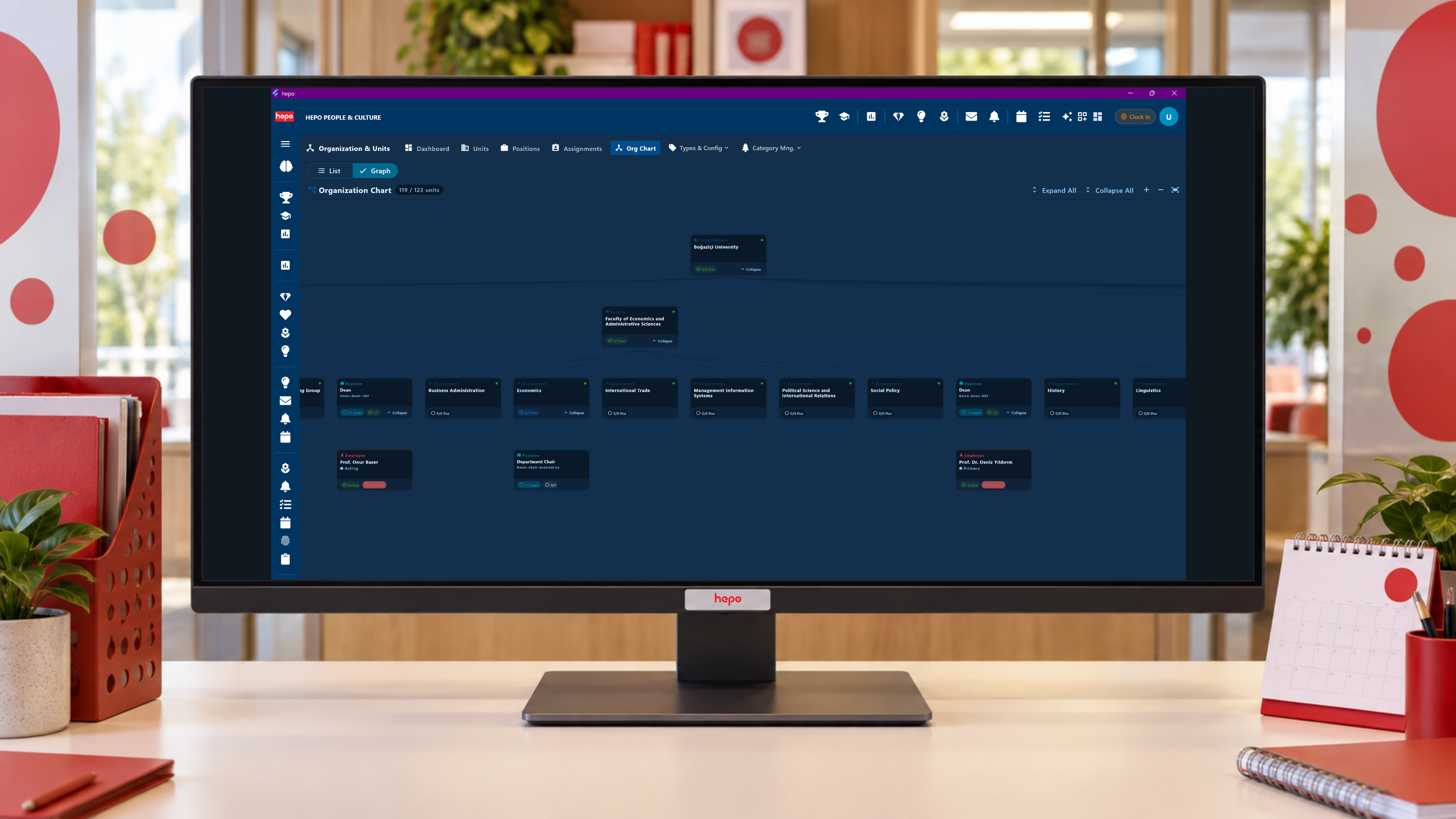
Operational Core — The Records Behind the Work
Manage the people, work, events, communication, knowledge, and relationships that support HEPO's three offerings alongside existing business systems.

Maintain organisational structure and effective assignments so work, participation, and review refer to the teams and responsibilities they concern.
Organization is HEPO's module for maintaining units, positions, assignments, and organisational relationships. Administrators represent the structure of the business as records; managers use that structure to understand responsibility, staffing, and the context of work.
The module supplies organisational context to the three offerings. A process that refers to a unit, or a cultural reading scoped to a team, needs an agreed record of what that unit or team means.
Units represent departments, divisions, teams, or other organisational groupings. Their relationships support the hierarchy the organisation chooses to maintain.
Positions describe seats in that structure and the responsibilities associated with them. A position remains identifiable when its occupant changes.
Assignments connect people to positions with relevant dates and status. They distinguish the current arrangement from an earlier one.
Reporting relationships express the lines the organisation has defined. An organisational relationship supplies context; the permissions and process bindings that use it still require configuration.
A person moves to a new position. The assignment-transfer operation records the end of the previous assignment and creates the new assignment with its effective date. Its checks consider the current assignment, the destination position, and relevant overlap conditions.
This preserves the distinction between where the person was assigned and where they are assigned now. Any approvals required by the organisation belong in the configured process; the existence of a transfer operation does not itself establish an approval policy.
A manager can review the updated hierarchy and related work. Responsibility for moving open tasks, changing access, or notifying other systems also needs to be assigned explicitly.
The hierarchy view presents units and positions. Dashboard summaries describe available structure records. Work, events, venues, and participants can be related to the units they concern, making the organisational context available for review.
The official structure may differ from informal collaboration. HEPO can hold declared relationships and relevant activity, but it cannot infer that an organisation chart fully describes how a team works. Those differences are useful subjects for discussion in People & Culture Orchestration.
The organisation and its consultants establish units, positions, effective dates, and the meaning of relationships. Implementers configure the records and transfer paths. Review one real assignment change with HR and the affected managers, including its effect on permitted views and connected work.
Employees owns the person reference; Accounts handles identity and participation. Together they give the structure named people and controlled access.