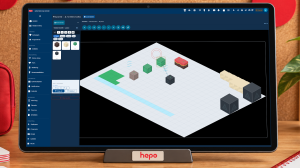
Simulation & Gamification
Explore connected information with FlowBox, rehearse changes in separate scenarios, and help people learn through interactive games within HEPO.

Practise decisions through interactive activities, feedback, and discussion; connect games to development journeys without turning results into personal judgments.
Games & Gamification provides interactive activities within HEPO for participation, learning, and enjoyment. An individual or a facilitated group works with a defined situation, makes choices, receives feedback, and can try another approach. It is a central part of the Simulation & Gamification offering.
For an organizational learning activity, the useful result is something participants can explain or practise: a handoff, a consequence, or an alternative way to coordinate. The activity supplies the experience; a development programme can give it a place in a wider journey.
Explaining a process is one part of helping someone understand it. Giving them a situation in which to make a choice creates another opportunity: they can see what follows, ask why and try a different approach.
The experience gives that choice meaningful objects, actions, and feedback in a setting designed around the subject. A facilitator can use it to start a discussion; participants can return to explore another possibility.
Imagine colleagues learning how work moves between several responsibilities. They have read the procedure, but a handoff remains abstract until they have to decide what to send, what to check or when to wait.
In a prepared exercise, participants make those choices within a bounded situation. The experience shows the consequences under its stated rules. The group can pause, examine the result and discuss which information influenced the choice.
A second attempt gives the discussion somewhere to go. Participants can change their approach and examine the difference, rather than ending with a general instruction to communicate better.
This is an illustrative learning use, not a claim about a particular customer's training results.
A useful game begins with what someone should be able to understand or practise. That purpose determines the setting, available actions and feedback.
For process familiarization, the experience might focus on the sequence of responsibilities. For collaborative problem-solving, it might ask participants to coordinate resources under stated constraints. For a facilitated development session, it can provide a shared situation in which people explain their choices and compare approaches.
The subject sets the rules. An engaging presentation helps people take part, while clear explanations help them connect the experience to the question it was designed to address.
An individual experience gives someone time to examine a situation at their own pace. They can inspect information, consider a choice and repeat an activity without holding up a group.
A shared experience gives participants a common situation to work through together. Their decisions and discussion become part of the session. The facilitator can use agreed stopping points to ask what people noticed, what information they relied on and what they would try next.
The experience defines who participates, which actions are available and what its results mean. A cooperative task can focus attention on a joint outcome. When competition is appropriate, its purpose and conditions should be explicit to participants.
The facilitator establishes the objective, starting information, permitted choices, and stopping points. Participants need to understand what feedback refers to and which rules make the exercise different from their actual workplace.
A shared session may mean people discussing one experience together. Its participation arrangements are defined for that activity; shared learning does not automatically imply online multiplayer or simultaneous remote control. After an attempt, ask participants what they noticed, what they assumed, and what they would change next time.
Gamification gives an activity a readable sense of progress: an objective to understand, feedback on an attempt and a meaningful next step. Recognition can acknowledge an achievement when the surrounding programme defines how it is earned.
The useful question is what the feedback helps someone do next. A participant may need to revisit a choice, inspect a missed piece of information or discuss a trade-off with colleagues. Progress becomes valuable when it supports that next action.
Results describe participation in the activity under its conditions. They do not, by themselves, establish a person's character, professional competence or suitability for a role. Those judgments require the appropriate evidence and human responsibility.
Each simulation is a self-contained experience within HEPO, with its own dataset, objects and purpose-built interface. Familiar navigation and controls help people move between experiences without learning a new application each time.
The setting can be a World of interacting objects, a Venue that makes a process recognizable, or another environment suited to the task. The objects change with the subject; navigation, inspection and access to controls retain a familiar character.
For facilitators, reusable experiences reduce the need to commission a separate interactive demonstration for every session. For participants, the convenience is direct: less time finding their way around and more attention available for the activity. Explore the environments →
Games & Gamification and Achievement Campaigns have complementary roles. A game provides the interactive activity. Achievement Campaigns and Programmes organise the wider development journey: enrolment, assigned activities, milestones and approved recognition.
A programme can give an experience its place in a longer sequence of learning and practice. The campaign retains responsibility for the journey and recognition; the activity retains its own rules and outcomes. See Achievement Campaigns & Programmes →
The wider games offering also accommodates experiences whose purpose is participation and enjoyment. For an organisational programme, the starting question remains what the experience contributes to the people taking part.
Choose a situation people encounter, a decision they find difficult or a relationship that is hard to explain. Identify the audience, the information participants need and the feedback that would make another attempt worthwhile. Those choices define an experience that can be evaluated on its usefulness.
See a facilitated-learning example → · Return to Simulation & Gamification →
Explore connected information with FlowBox, rehearse changes in separate scenarios, and help people learn through interactive games within HEPO.
Explore connected work in HEPO: focus on a concern, inspect relationships and source context, and carry a clearer question into scenario rehearsal.
Choose among Space, Graph, World, City, and Venue around the question, information, actions, and explanations your team needs.
Choose a starting situation, adjust permitted inputs, and compare modeled or rehearsed alternatives with their assumptions and authority boundaries clear.
Follow three illustrative HEPO sessions: delivery pressure, process delays, and shared learning, with preparation, participant actions, and useful next steps.
Interpret operational information, playback, scenarios, and exercise feedback using their sources, units, time, assumptions, and decision context.