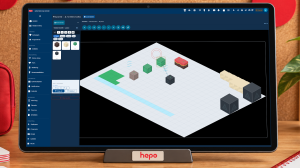
Simulation & Gamification
Explore connected information with FlowBox, rehearse changes in separate scenarios, and help people learn through interactive games within HEPO.

Choose among Space, Graph, World, City, and Venue around the question, information, actions, and explanations your team needs.
HEPO's Simulation & Gamification offering uses five presentation environments: Space, abstract Graph, World, City, and Venue. Each gives participants a different way to explore relationships, follow activity, or practise a situation. This page helps a team choose a representation around the question it needs to answer.
The environment supplies the setting and interaction. The particular experience supplies the information, objects, rules, and meanings. Choosing a City view, for example, does not supply a complete transport model or automatically turn business records into a modeled city.
A different representation can make a difficult question easier to approach. A list helps you find a value. A path helps you follow a sequence. A spatial setting helps you understand where activities meet.
HEPO builds simulations and interactive experiences around that choice. Perception concerns what becomes noticeable: a relationship, a change, a concentration of activity. Perspective concerns how you examine it: through connections, a sequence, a world or a particular place.
"Point of view is worth 80 IQ points."
Alan Kay, The Early History of Smalltalk
Kay's observation expresses the value of a useful thinking tool. Here, the practical question is which view helps your team understand the situation in front of it.
A Space experience brings related information into an arrangement you can explore. Grouping, proximity, relative size and movement make selected aspects of the relationships easier to notice. Inspection explains what each cue means.
For a delivery discussion, the concern might be unfinished work. Its surrounding relationships can bring capacity, incoming requests and delivery outcomes into the conversation. You can focus on one connection without abandoning the rest of the situation.
Useful question: “What is connected to this, and where should we look more closely?”
A Graph makes connections and sequences explicit. Steps, branches and handoffs provide a readable structure for examining how work proceeds. The setting can remain abstract because the path itself is what matters.
A process owner can follow a recorded execution, inspect where it waited and distinguish a repeated attempt from a completed step. A rehearsal can use the same kind of representation while remaining clearly identified as an exercise.
Useful question: “Which path did the work follow, and where did it wait?”
A World gives objects a coherent spatial setting. Their arrangements and interactions help people explore how the parts work together. The experience supplies the objects, actions and rules relevant to its purpose.
For example, a learning exercise can let participants arrange resources and examine the consequences under its stated rules. They can discuss what changed when they tried a different arrangement, with the world providing a shared reference for that discussion.
Useful question: “How do these parts work together?”
A City uses places, routes and connections to make a wider setting understandable. It gives people a way to examine activity across locations while retaining a sense of the whole.
An illustrative experience might explore how activity at one location relates to demand or handoffs elsewhere. The places and routes represent the scenario's subject; their meaning is defined by the experience. This perspective can help a group discuss coordination beyond a single team or site.
Useful question: “How does activity in one place relate to the wider operation?”
A Venue focuses on a particular place: an office, factory, construction site or another setting where work happens. Objects and activities gain context from the place they occupy.
A facilitated exercise might use a venue to explain responsibilities, handoffs or the sequence of an activity. Participants can connect the discussion to a recognizable setting while inspecting the information behind it. The venue's purpose determines which details need to be represented.
Useful question: “How does work unfold here?”
We start with the situation your team needs to understand and the questions it needs to ask. Together, those define the information required. We then choose an environment that makes the relevant relationships readable and give the experience meaningful objects, controls and explanations.
An approval path may benefit from a Graph. Relationships around a delivery concern may be clearer in Space. A place-based exercise may call for a Venue. The choice follows the task; it does not require every dataset to appear in all five forms.
Each simulation is a self-contained experience within HEPO, with its own dataset, objects and purpose-built interface. Familiar navigation and controls help people move between experiences without learning a new application each time.
That combination makes reuse practical. The subject can change while the basic experience of navigating, inspecting and working with inputs remains familiar. Domain preparation still determines whether the simulation asks a useful question and produces an interpretable result.
Ask a participant to select an object, explain one relationship, and find the value or rule behind it. For a recorded path, they should be able to distinguish a possible branch from one the recorded run actually took. For a learning world, they should be able to explain the rules that produced a consequence.
The five environments describe the offering's family of experiences, not a promise that a particular installation contains every industry model. The chosen experience must fit its sources, audience, and purpose. A static or textual explanation also helps participants who cannot rely on movement or visual cues alone.
Start with something people find hard to explain, rehearse or learn. Agree what they need to notice and what they should be able to do. That provides a concrete way to judge whether a perspective helps.
Explore connected information with FlowBox, rehearse changes in separate scenarios, and help people learn through interactive games within HEPO.
Explore connected work in HEPO: focus on a concern, inspect relationships and source context, and carry a clearer question into scenario rehearsal.
Choose a starting situation, adjust permitted inputs, and compare modeled or rehearsed alternatives with their assumptions and authority boundaries clear.
Practise decisions through interactive activities, feedback, and discussion; connect games to development journeys without turning results into personal judgments.
Follow three illustrative HEPO sessions: delivery pressure, process delays, and shared learning, with preparation, participant actions, and useful next steps.
Interpret operational information, playback, scenarios, and exercise feedback using their sources, units, time, assumptions, and decision context.