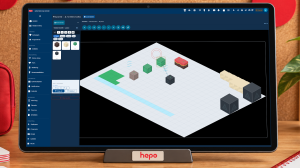
Simulation & Gamification
Explore connected information with FlowBox, rehearse changes in separate scenarios, and help people learn through interactive games within HEPO.

Interpret operational information, playback, scenarios, and exercise feedback using their sources, units, time, assumptions, and decision context.
A result in HEPO's Simulation & Gamification offering may describe an operational record, replay an execution, show a modeled scenario, or provide feedback from an exercise. This guide helps participants identify which account they are examining and decide what it can support.
The practical task is to connect what you see to its source, quantities, time period, and assumptions. That connection lets a team carry a specific finding or proposal into review while keeping responsibility with the appropriate people.
HEPO keeps those distinctions available as you explore. A recorded event, a prepared exercise and a possible future outcome each have a different meaning. Their presentation should help you retain that meaning throughout the session.
| What you see | What it means |
|---|---|
| Operational information | Records or published information from an identified source, with the relevant capture time and context |
| Recorded playback | A sequence based on supplied execution events; gaps in the record remain gaps |
| A prepared rehearsal | An illustrative situation with stated conditions and a defined purpose |
| A scenario result | An outcome produced by a model from the scenario's inputs and assumptions |
For example, a delivery discussion might begin with unfinished work captured at a particular time. It could then explore a scenario with additional incoming work. The first describes the starting information. The second describes what the model produces under changed conditions.
Keeping them distinguishable lets the team discuss the proposal without mistaking it for a new operational fact.
A larger object, a visible flow or a prominent relationship helps direct attention. Inspection supplies the meaning needed to interpret it: the relevant value, unit, time context, source or explanation.
In a Works experience, work waiting is a stock, capacity is a rate and a work limit is a threshold. A visually similar treatment must not erase those differences. The exact values and labels remain important even when the broader pattern is easy to notice.
Changing how you look at the scene does not change captured facts. You can focus, zoom and reveal more information while keeping the underlying account intact.
A relationship can mean several things. One activity may depend on another. Work may flow between steps. Two outcomes may be associated in the available evidence. A model may describe an assumed response to an input.
Those meanings deserve different explanations. A line between two objects does not, by itself, establish cause. A modeled response depends on the model's scope and assumptions. FlowBox keeps the relationship's declared meaning available for inspection so that a visual connection can lead to a better question.
A view can animate to help you notice a relationship. Recorded playback has source-event timing. A scenario has a declared model period and progression. Those are different clocks.
Slowing the animation does not mean the business process took longer. A one-day scenario step is a declared interval in the experiment, not a day of observed work. When timing matters to the question, inspect the source duration or model time and its units.
An absent value should not silently become zero. An incomplete execution record should not become a complete animated story. Information that is unavailable or outside the current view remains distinguishable from an observed absence.
This is useful during investigation. The group can identify which part of an explanation is supported and where another source or question is needed. A simulation can help reveal a limit in the available information as well as a pattern within it.
Experiences use the information people are authorized to access through HEPO. A different representation does not grant access to another person's restricted records or explanations.
Scenario work also remains separate from changes to actual operations. Exploring an input or resetting an experiment does not apply that change to the source records. A decision to act follows the appropriate process and permissions.
Read how security follows the actor → · Explore Ethical Management as a Solution
People should be able to examine important information without relying solely on movement, colour or precise pointer control. Text, values, legends and inspection provide additional ways to understand what the experience represents. Reduced-motion presentation keeps the meaning available while changing how it is shown.
These alternatives also help a meeting. One participant may notice a visual pattern while another needs to examine the quantities. Both should be able to connect their interpretation to the same information.
Before relying on a scenario, ask what starting information it used, which inputs changed and which assumptions matter to the conclusion. Consider what lies outside its scope and who can validate the interpretation.
That conversation gives the result its practical role. It can clarify a trade-off, identify a question to investigate or support a proposal for review. Responsibility for the decision remains with the people who have the context and authority to make it.
Explore connected information with FlowBox, rehearse changes in separate scenarios, and help people learn through interactive games within HEPO.
Explore connected work in HEPO: focus on a concern, inspect relationships and source context, and carry a clearer question into scenario rehearsal.
Choose among Space, Graph, World, City, and Venue around the question, information, actions, and explanations your team needs.
Choose a starting situation, adjust permitted inputs, and compare modeled or rehearsed alternatives with their assumptions and authority boundaries clear.
Practise decisions through interactive activities, feedback, and discussion; connect games to development journeys without turning results into personal judgments.
Follow three illustrative HEPO sessions: delivery pressure, process delays, and shared learning, with preparation, participant actions, and useful next steps.