System Layer — Shared Services Behind HEPO
Understand HEPO's shared security, data, integration, local AI, workspace, and extension services, and how to evaluate them in your deployment.

Author module and capability definitions, preview supported generation, and review the resulting artifacts before integration and release.
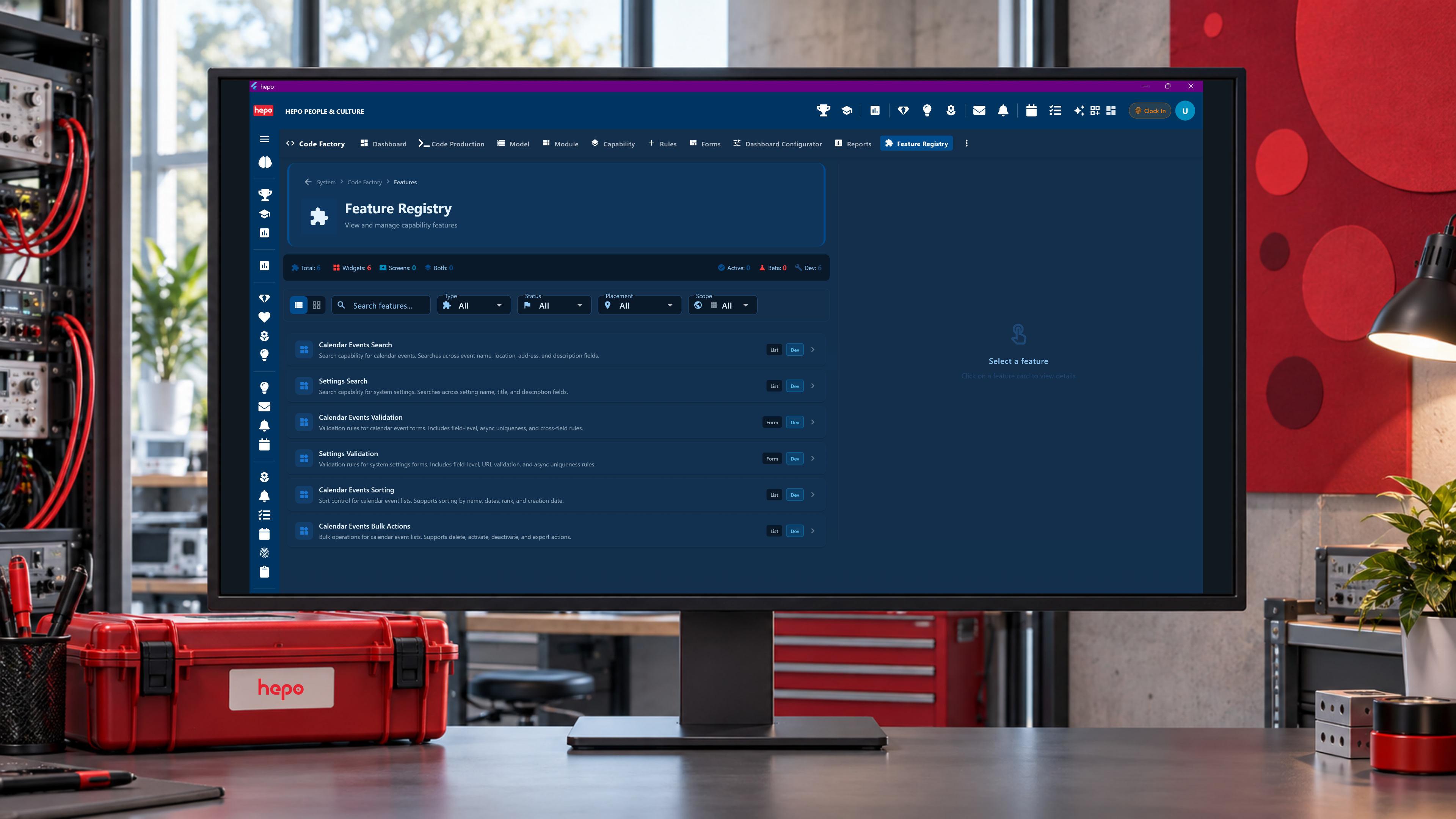
Code Factory is HEPO's tooling for defining and generating module and capability artifacts. It brings together manifests, model and interface definitions, configuration, and supported generation commands. Implementers use it to produce repeatable platform structures and examine the result through an authoring surface.
The aim is to reduce repeated construction work. The generated output still needs to satisfy the business requirement and pass the relevant integration and release checks.
A new capability needs a clear record model, fields, permitted operations, presentation, and any specialised rules. The factory's definition and manifest surfaces organise those concerns so supported generators can use them consistently.
Module definitions, capability definitions, models, forms, rules, widgets, features, and dashboard configuration each describe part of that structure. Their relationships matter: a form depends on the intended model and operations, while a displayed capability needs the appropriate registration and navigation.
| Step | Useful result |
|---|---|
| Define the requirement | A concrete account of records, actions, and responsibilities |
| Select or author definitions | Inputs for the supported generation path |
| Validate and preview | Feedback on prerequisites and the artifacts the command intends to produce |
| Generate | Artifacts and execution output for inspection |
| Review and integrate | A checked connection to the platform's data, operations, permissions, and interface |
| Verify and release | Evidence that the implemented capability behaves as intended |
The authoring surface can invoke supported commands without manually entering them in a development terminal. Generation still runs through an installed toolchain and supported environment. Custom business behaviour, deployment, and verification may require engineering work; a completed generator command is not a production acceptance result.
Common Canvas arranges existing views. Shared Module renders supported data surfaces from configuration. Code Factory works at the artifact level when a module or capability needs further structure.
That preserves the original progression from views to data surfaces to modules. The organisation owns the requirement and definitions; the platform supplies reusable patterns and tooling. The choice depends on what the required behaviour actually needs.
Shared patterns provide a route into common interfaces, process registration, and relationships. Permissions, validation, audit coverage, and data handling must still be checked in the generated and integrated result. The generator cannot establish the correctness of a business rule solely from its presence in a definition.
Implementers walk the organisation's technical team through a representative capability, including a preview, the resulting artifacts, a validation failure, and the release checks. Consultants and business owners confirm that the completed behaviour serves the intended work.
Scalability places this extension path in the wider growth model.